During an interview there can be a variety of different purposes as to why the interview is taking place. Also you can also receive a lot of information on a topic. So this means that a lot of different interview techniques can be used in the interview to extract the information that you want out of your interviewee. Purpose of Interviews
Research
Understanding
Inform
Interpretive
Emotional
Research A research interview an interview which takes place so that you can get the interviewees knowledge about the topic that is being discussed as usually the person who you are interviewing is an expert in the field you are asking about.
Understanding This type of interview most likely takes place to increase the audience's awareness on the issue and certain topic or topics that are being spoken about.
Inform This type of interview is used for the purpose of sharing information with the audience https://www.youtube.com/watch?v=2tHrUr_ozZs The interview above is informative as
it gives you some back ground information on guardians of the Galaxy and what it was like to film. It also gives information on the television show parks and recreation. It also informs people all about the film which could encourage them to watch it. Interpretive This purpose of interview is used to express or explain someone's certain opinion to the audience. https://www.youtube.com/watch?v=KzYJccxLSFA
The interview above between Bear Gryills and Piers Morgan's is interpretive as it shows the audience Bear Gryills friends and wife's opinion on him.By it being this type of interview it allows the audience into Bar Gryills life to find out more about him and help them to understand him more.
Emotional This interview purpose is used to be able to get the audience to see the story or situation from someone else's point of view. These interviews would be more personal due to the topic that is being spoken about and they would also likely be informal as they need the interviewee to open up and answer the questions. https://www.youtube.com/watch?v=2BWs6T3HjhU This is an emotional interview above because it allows the audience to see how Angelia Jolie feels about a certain topic and issue. This type of interview allows the audience to see how she feels about what she went through. This also helps the viewers to know more in-depth about what happened.
There are many different types of interviews these days and also many different places that you can view them. The context of the interview relates solely to where that certain interview is being broadcasted from and for what purpose. Also it could change the mood of the interview depending on which sort of interview you are talking part in and for what reason. There are four different places that journalistic context
can be broadcasted from Radio, print, online and television. Based on where the interview is being broadcasted or published how it is pretended and the structure change to fit the suitable place. These are some of the many other types there are:
Print (Newspapers and magazines)
Television
Radio
Online
News
Sport
Feature-Writers
Editorial writers
A feature writer is a main writer and reporter for a magazine and writes anything from hard news to human interest. They also have strict deadline that they have to stick to. Whereas an editorial writer is the managing editor and only write opinion or themed pieces a few times a month.
Radio
In the media industry the radio have to put in a lot more work to ensure that the audience know everything about the interview such as who is being interviewed, why they are being interviewed and also where the interview is being broadcasted from. Due to the fact that the audience can't see what is going on they have to be able to create a good image in the audiences mind so they can imagine that they are part of it. They accomplish this goal by using things such as vox pops(voice of the people), relevant theme tunes and sound effects. The interview of the certain person related to the topic will either be interviewed in the studio or at a place relevant to the interview and the story. Also due to the interview being recorded this is where they will obtain their sound bites which they may use later in in the show. Depending on the type of interview that is taking place the way the questions are asked could change, such as if its an entertainment interview it will most likely be with a well-known celebrity that the majority of people will know and will be doing that interview for one of two reasons either to promote themselves or their product such as a film or an album. Whereas if the interview is being used for a documentary the interview will be more formal than it was for the entertainment interview and the interviewer will be interviewing the main people to do with the topic such as experts or the people who were involved and experienced it. Online Nowadays you are able to access the news and other types of interviews wherever you are through using the internet. Through using the internet you can catch up on news that you have missed as most newspaper and magazine companies along with radio station have access to their own website where they post the latest stories as they break. They can also go into a lot more detail online as they have the capabilities to post links and videos about the story. Television Through the use of television all types of news are able to be broadcasted but the main ones that we see broadcasted mostly are entertainment, hard news, human interest and promotional. Hard news, human interest and investigative shows are broadcasted throughout the day on a daily bases for example the news at six, where as the promotional and entertainment side of things are usually shown at the weekend on a Friday or Saturday night some good examples of this are shows such as Alan Carr's Chatty Man, Graham Norton and The Jonathan Ross show. These chat shows include celebrity guests being interviewed to promote something they have coming up. Print
Broadcasting the story through the use of print allows for the writer to become more creative depending on the story and also allows for them to go into more detail. In the article that is produced you always see the use of the 5 W's and H (who, what, where, when, why and how), through the use of these it makes sure that the main points are always in the story. The interviews you see published in newspapers and magazine will always be set out differently and this is to show the difference between the type of news stories they are writing about, as magazines are set out in a more informal way as they are usually stories on gossip columns and entertainment whereas newspapers are set out in a more formal way using bold dark headlines and sub headings as the stories they report on are more hard news stories so the magazine has to look serious in order to catch the audiences attention as a hard news story.
Sport These revolve around anything that happens to do with sport. Interviewers usually try to get interviews with team captains, sports stars and fans that have been or are present at the game that is to do with the story. They also show the highlights of the game and replays of the game usually on shows such as Match of the Day at a later time in the day where they also inform the audience of the scores. News
News shows such as the BBC News at Six or the ITV News mainly focus on hard news stories and investigative stories with the odd human interest story. This types of show is a good way of finding out peoples opinions and feeling on the event that has happened as the interviewer would usually try and interview witnesses who saw it happen so that they could investigate more for their story and if possible the victims. The news packages that are shown on the news are usually pre-recorded unless it is happening there and then.
All interviews that take place or have taken place no matter if it's a good or bad one have to follow or should follow the interviewing structure. Interviewing Structure
Intro
Developmental Questions
Confidence Building
Key Questions
Sound Bites
Summary
Wind-Up
Intro All interviews start with an introduction, this is used to introduce the guest or topic being discussed to the audience. It can also help to boost the guest's confidence about the interview through the way they are introduced by the host. Developmental Questions
Developmental questions lead on from the introduction of the guest or topic in good interviews. These are used to help to set the mood of the interview and can help to relax the guest and ease them in to the conversation. The questions are usually light heated, an example of this would be saying, "Welcome, how are you feeling today?". These developmental also can be used to help build rapport from the very beginning of the interview.
Confidence Building
Next in the interview structure come the confidence building questions these are asked before the key questions and are used to help build up the interviewees confidence so that when you ask your key questions they open up more and give you more detailed answers to your questions. Another advantage of asking confidence building questions before the questions is that it will help to get rid of any nerves the interviewee may have. Key Questions The key questions are the chunk of the interview and are the most important part of the interview as they are normally what the interview is based around. The key questions are usually asked around the middle of the interview as you have given the guest chance to relax and get comfortable which means they are more likely to open up. However if the key questions are sensitive, emotional and personal they are more likely to be left until near the end of the interview so that they feel even more comfortable answering your questions.
Sound Bites Sound bites are generated after the interview usually from the most important part of the interview which will be the key questions. These sound bites will likely be used afterwards on the radio or in news packages and VT's. Summary The summary of the interview is where you ask one more final question at the end of the interview which would normally be related to the key questions you have asked and this helps to wrap up the whole interview. Wind-Up
The wind up part of the interview is one of the last things you do and it just brings the interview to a close. You would leave the interview on a light hearted note and thank the guest for taking time out to be interviewed no matter if you had different opinions on the matter, this is so that you can ask for another interview in the future.
The interview above between Taylor Swift and Alan Carr is a good example of excellent interview structuring as Alan Carr follows it perfectly and when you watch the interview you can see this.
Alan Carr starts the interview off by introducing Taylor Swift as, 'The biggest thing in pop' and also he offers her a drink which can help to make her feel more welcome. He then moves on to his developmental questions when he asks her about her moving into her new apartment in New York and she answers by talking about how
it used to belong to Sir Ian McKellan and how long it took her to be able to
view it. Also they talk about the last
time she was here and he gives her a cat picture which helps the audience to see that it will most likely be a light hearted interview. This shows that through him following the structure she is starting to open up and that it is helping to build rapport between the two. He then asks her the confidence building questions by asking about her family and cats and says to her, "So you are back with your new album", which also boosts her confidence as that is what she is there to promote. This question also leads on to the key questions of the interview where he asks about her new album and how she promoted it through having house parties at her home with her fans. By her giving out so much information so freely, shows that she feels comfortable to do so. The sound bite for the interview if needed is generated from the interviews key questions. Alan Carr then summarizes the interview by going back to talking about her album and talks about how she's about to perform her new song from her album. He winds up the interview by saying, "Thank
you to Taylor here’s her latest song."
There are many different interview styles which are used in different aspect of interviews depending on the topic of the interview and the answer that is needed.
The types of interview styles used are:
Hard News
Human Interest
Entertainment
Investigative
Promotional
Combative
Hard News
Hard news is news that affects people's everyday life. They are serious stories that usually relate to ongoing or new wars, taxes, new laws and politics. These stories are usually broadcasted on the news at six or the news at 10. http://www.bbc.co.uk/iplayer/episode/b06gxyjw/bbc-news-at-ten-15102015 This clip is an example of hard news as it is being shown on the news at 10 and the story told about the NHS is classified as a
hard news story because the anything affecting the NHS affects us whether it be
problems with care, more Doctors and Nurses signing up to active duty, or the
NHS becoming a private sector which will affect us greatly as it means that we will have to pay for our health care. Human Interest
Human interest is usually known better as soft news and is news that doesn't affect people's everyday life but they show an interest in it, an example of this would be the birth of the new royal baby.
The clip shown above is a good example of human interest, this is because it is soft news that doesn't affect people's everyday life but they show an interest in it as it has to do with Royal family which in today's day and age is something that is considered by people as really important.
Entertainment
Entertainment news is news that relates to celebrities, music and films. This is news that entertains people when they read it, chat shows such as Alan Carr or graham Norton are examples of this. These
interviews are similar to the promotional interview and sometimes overlap.
In this interview shown above, Angelina Jolie talks about her children, her marriage to Brad Pitt, the work she does in different countries and how this has affected her life. This interview is an example of an entertainment interview because even though it won't affect people's everyday lives they still want to know about it.
Investigative
Investigative news is an interview where it is investigated in more detail to find out the true and real story. This sort of interview would normally be about conspiracy theories and you would usually see this in documentaries.
Promotional
Promotional news is usually where something is being promoted such as a celebrity promoting a film, CD or television programme. The celebrity who is promoting the product is usually paid to do so.
This interview is a promotional interview because they are
speaking about the film he is staring in and he also speaks about why he wanted to be in the film and
why he enjoys playing the character. So as the interview is talking mainly about the new film it is classed as promotional.
Combative Combative news is a type of interview where the questions are forceful and asked over and over again until they get the answer that they want. This type interview is usually seen to be used on politicians or heads of companies who have had media training so they know how to avoid answering the question.
The interview shown above shows Jeremy Paxman interviewing the Head of Coke and is a combative interview as Jeremy Paxman asks the same question to the head of coke about if people go to the cinema and get a small cup of coke do you think they know how much sugar is in it. The interview becomes more combative after this question is asked because the Head of Coke tries avoiding the question and never gives an answer and towards the end you can see the Head of Cokes opinion changing.
The type of body language used in the interview can make a huge difference during the interview and can either make the interviewee close or open up. The open body language used in an interview such as keeping eye contact, sitting facing each other and mirroring are good ways to keep the interview going smoothly through out. Also another sign of good and open body language is active listening which consists of the interviewer nodding when the interviewee answers the question and also it shows active listening when the interviewer's next question leads on from the last answer. Good Body Language Mirroring
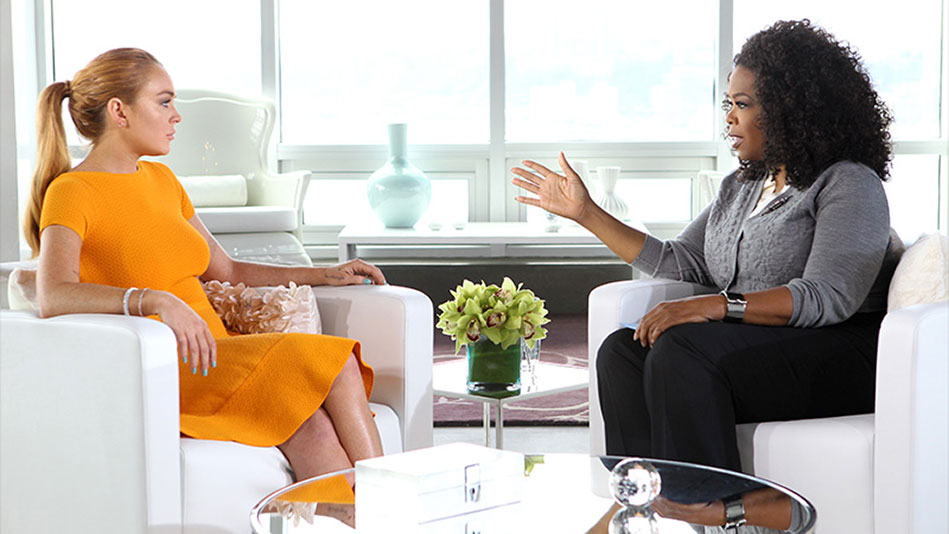
A good example of good body language in an interview is when you can see the interviewer and interviewee sitting facing each other, this is known as mirroring. When mirroring happens in an interview you can tell that they are comfortable and happy to answer the questions as they are usually leaning in towards each other. This form of good body language also helps to build up rapport in the interview.
The still shot shown above shows a good example of mirroring during Oprah Winfrey's interview with Lindsey Lohan. During all of Oprah's interviews you see this technique used a lot. In the image you can see them mirroring each other and this is helpful to make the interviewee feel comfortable and makes them want to open up more to the interviewer. Also through the image you can see that they are sat facing each other with their knees pointed towards each other and their arms open which shows good body language.
Active listening
Another form of good body language in an interview is active listening this is usually shown when the interviewer nods throughout. Active listening can also be shown when the interviewer says 'what do you mean by that' or 'tell me more' as it shows that they have been listening to the answer given.
This form of good body language can also be shown when the interviewer follows on from the latest answer with a question related to that certain answer.
Eye contact
Eye contact is another good form of body language that can be used in an interview. By keeping eye contact throughout most of the interview shows that the interviewer and interviewee are listening and this can also contribute to them feeling comfortable and opening up more during the interview and giving out more information on the topic than normal. Building Rapport
Building rapport is when your questions and body language help to build up a level of trust and understanding with the person that you are interviewing. Even if you maybe don't agree with their opinion you can still build rapport with the interviewee, an example of this would be an interview with politicians as they more than often don't agree with each other's opinions but still have good relationships throughout the interview. An advantage of building rapport is that they will become more comfortable in the interview and more likely to share more information and may allow the interviewer to ask more sensitive questions as Oprah Winfrey does with Lindsey Lohan. However a disadvantage of building rapport is that the interview could become to informal and could end up leading completely off topic.
Bad Body Language
Bad body language in an interview can cause the interview to become very closed off and could mean that the interviewee doesn't give out any information when a question is asked and could in the end lead the interviewee standing up and walking out. Examples of bad body language in an interview could be classed as sitting with their arms crossed, no eye contact and facing away from the other person who is speaking. These examples of bad body language are completely opposite to open body language.
The interview above between Grace Jones and Russell Harty is an example of bad body language, this is because throughout the interview Russell Harty keeps on turning his back on Grace Jones and talking to the other guest next to him. Also during the interview he was dismissive, laughing at her and he also entered her personal space by putting his hand in her face. This interview between Grace Jones and Russell Harty could have been handled a lot better as he could have sat them both on one side of him like they do on Alan Carr, Graham Norton or Jonathan Ross so that Grace Jones felt more included in the conversation.